



This SEO blueprint explains keyword research, on-page SEO, technical SEO, and off-page SEO strategies. It provides a structured roadmap to improve rankings, build authority, and drive consistent organic traffic using proven, data-driven optimization techniques.
Visibility serves as the absolute lifeblood of any online enterprise. Whether you run a bustling e-commerce store, a personal blog, or a corporate website, optimizing your pages to rank higher remains a critical priority. You need a reliable system to achieve these goals. That is exactly where this comprehensive SEO blueprint comes into play.
This detailed guide walks you through every critical element of search engine optimization. We cover foundational concepts, strategic keyword research, and vital on-page SEO enhancements. We also dive deep into technical SEO refinements and authoritative off-page SEO tactics. By following this clear roadmap, you gain exact directions to elevate your organic performance and attract highly qualified visitors.
Businesses that invest heavily in a holistic SEO blueprint experience sustainable traffic gains and stronger brand credibility. They also see significantly better returns on their marketing investments. Unlike short-term ad campaigns, a robust approach to search engine optimization compounds over time. This offers enduring visibility and a massive competitive advantage. Throughout this guide, you will find actionable tactics and best practices to transform your online presence completely.
Understanding Core SEO Fundamentals
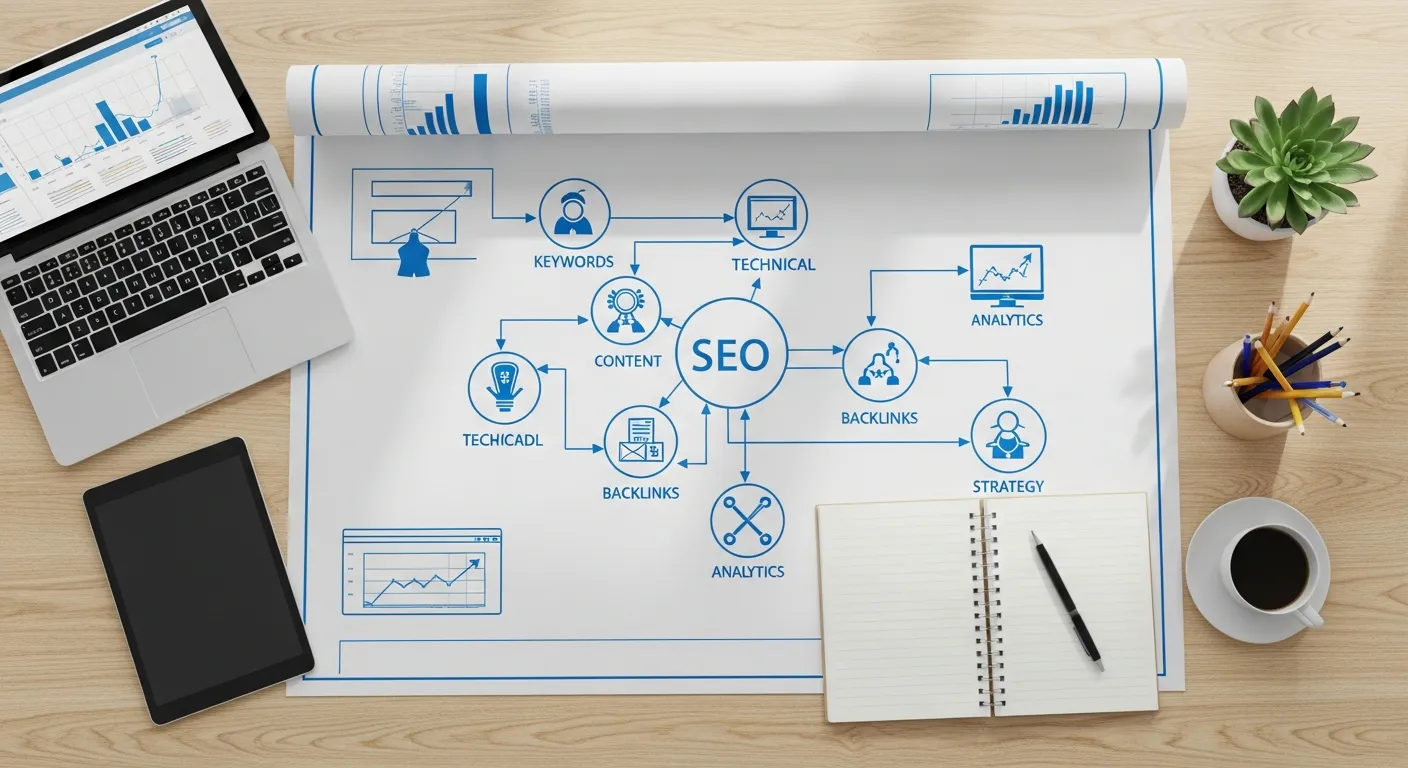
At its core, search engine optimization involves aligning your website content and technical setup with strict search engine algorithms. These algorithms evaluate hundreds of unique signals to determine which pages best satisfy user queries. Mastering these fundamentals remains an absolute prerequisite for brands aiming to stand out against fierce digital competition.
Search engines constantly crawl and index your pages. They assess critical factors like content relevance, user experience, and overall site performance. When you execute an SEO blueprint effectively, you boost your rankings while enhancing usability. You actively foster trust among your visitors by delivering exactly what they need.
To build a truly robust digital marketing strategy, you must understand the primary pillars of optimization. Every successful SEO blueprint relies heavily on balancing these distinct but deeply connected disciplines.
- On-Page SEO: This involves fine-tuning page-level elements like titles, headings, copy, and multimedia for maximum relevance.
- Technical SEO: This requires optimizing server performance, mobile compatibility, and crawlability to ensure efficient search engine access.
- Off-Page SEO: This focuses entirely on building domain authority through high-quality backlinks and strong social signals.
- Keyword Research: This serves as the foundation, discovering exactly what terms your target audience types into search bars.
Understanding these core components marks the first step in leveraging a successful SEO blueprint. Each pillar plays a highly unique role. When combined, they create a powerful synergy that drives massive organic growth.
To explore more about these basic concepts, see Ahrefs’ SEO introduction Explore SEO Basics
The Synergy of the Core Pillars
|
SEO Pillar |
Primary Goal |
Key Tactics |
|---|---|---|
|
Keyword Research |
Discover user intent |
Search volume analysis, competitor gap analysis |
|
On-Page SEO |
Prove topical relevance |
Meta tags, heading structure, content quality |
|
Technical SEO |
Ensure crawlability |
Site speed, mobile responsiveness, XML sitemaps |
|
Off-Page SEO |
Build domain authority |
Backlink acquisition, digital PR, brand mentions |
Conducting Effective Keyword Research

Keywords serve as the vital bridge between user intent and the content you provide. Without a thoughtful keyword research strategy, even the most well-crafted pages will fail to attract targeted visitors. Through this SEO blueprint, you will learn how to identify high-value phrases efficiently. You must balance search volume with realistic competition levels.
Begin your keyword research by brainstorming seed topics highly relevant to your niche. Consider the specific questions your audience asks at each stage of the buyer journey. Jot down broad themes, such as product categories or common industry challenges. You will then expand these into longer, more specific queries using specialized software.
Leverage robust solutions like Google Keyword Planner to gather accurate data on search volume and keyword difficulty. For example, a general term might show thousands of monthly searches but wildly impractical competition. Conversely, a long-tail variant could offer a smaller yet much more engaged audience ready to convert.
Mapping Intent Through Keyword Research
Competitor analysis serves as another vital step in your keyword research process. Advanced tools enable you to reverse-engineer top-ranking pages easily. You discover exactly which phrases bring your rivals the most traffic. This incredible insight helps you refine your list by filtering out overly saturated terms.
Once you assemble an extensive keyword inventory, organize it into a highly detailed map. Assign primary targets to your core landing pages. Designate secondary or supporting terms to related blog posts. This mapping prevents internal competition, often known as keyword cannibalization.
By following these strict keyword research practices, you lay the perfect groundwork for your SEO blueprint. You set the stage for highly effective content creation and targeted on-page SEO execution.
Implementing On-Page SEO Techniques
On-page SEO represents the exact point where strategy meets execution. Now that you possess a structured keyword map, you must optimize individual pages. This critical phase of the SEO blueprint guides you through improving relevance, engagement, and overall visibility.
Begin your on-page SEO journey with optimized title tags. Place your primary focus keyword as close to the front as possible. Craft a highly compelling headline that instantly entices user clicks. Keep your titles under 60 characters to completely avoid truncation in search results.
Complement each title with a persuasive meta description. Keep this description under 155 characters while highlighting clear user benefits. Include your target keyword naturally without ever resorting to keyword stuffing.
Content Quality and Heading Structures
Heading hierarchy plays a massive role in content clarity and search engine crawlability. Use a single H1 tag per page for the main topic. Follow this closely with logical H2 and H3 subheadings to break up your text. Proper on-page SEO structure improves readability and signals topic organization to algorithms.
Content quality must never take a back seat to word counts. While longer posts often perform better, your absolute priority involves answering user questions fully. Aim to provide tangible, actionable value. Weave your primary keyword naturally within the first 100 words of your introduction.
Integrate semantic variations throughout the body of your text. This advanced on-page SEO tactic helps search engines understand the broader context of your page. It prevents your content from sounding robotic or highly unnatural to human readers.
Strategic Internal Linking
Internal linking further enhances your overall site architecture. Link related articles together using highly descriptive anchor text. Ensure this anchor text includes relevant keywords naturally. This vital on-page SEO practice distributes authority evenly and encourages visitors to explore additional resources.
Finally, do not overlook basic image optimization. Compress all media files for drastically faster load times. Use highly descriptive file names and include meaningful alt text. By mastering these on-page SEO tactics, you bring your SEO blueprint to life.
Ensuring Technical SEO Excellence
The technical health of your website completely underpins every single aspect of optimization. Within this SEO blueprint, the technical SEO phase focuses on delivering a totally seamless user experience. Search engines must crawl, render, and index your pages efficiently.
Page speed remains a confirmed ranking factor and a highly critical user experience metric. Utilize diagnostic tools to identify prime opportunities for image compression and code minification. Enabling browser caching shaves milliseconds off your load time. This technical SEO fix drastically reduces bounce rates.
Mobile compatibility proves just as vital for organic success. Search engines now predominantly use the mobile version of your site for ranking and indexing. Ensure responsive design, easy navigation, and appropriately sized tap targets.
Crawlability and Indexation Best Practices
Creating an accurate XML sitemap helps search engines discover all your valuable pages instantly. Concurrently, a thoughtful robots.txt file guides crawlers smoothly away from duplicate or low-value sections. This critical technical SEO step preserves your valuable crawl budget.
Security serves as another absolute non-negotiable requirement. An SSL certificate that switches your site to HTTPS protects sensitive user data. Search engines give distinct preference to secure sites, making this technical SEO upgrade completely essential.
You must also implement structured data using JSON-LD markup. This allows you to qualify for eye-catching rich snippets, such as review stars and FAQ accordions. Schema markup drastically enhances your search listings and improves click-through rates.
For a deeper understanding of technical standards, see the SEO fundamentals resource—Google’s official starter guide is available at the following alt line: Google SEO Starter Guide
Building Authority with Off-Page SEO
Off-page SEO revolves entirely around signaling expertise, trustworthiness, and high authority to search engines. In this comprehensive SEO blueprint, this stage focuses on earning high-quality backlinks. You must foster deep brand recognition through strategic outreach and robust content promotion.
Not all links carry the exact same weight. A handful of glowing endorsements from highly reputable, industry-specific domains works wonders. These carry vastly more weight than dozens of low-quality, spammy references. Your off-page SEO strategy must focus heavily on quality over quantity.
Identify authoritative digital publications, professional associations, and educational institutions aligned with your niche. Craft highly personalized outreach proposals. Highlight your unique research findings or expert insights in exchange for a valuable guest post or brand mention.
Broken Link Building and Digital PR
Broken link building serves as another incredibly powerful off-page SEO tactic. Discover pages in your field containing totally obsolete external links. Approach the webmasters with a courteous suggestion to replace the dead reference with your highly relevant resource.
Consistent content promotion severely amplifies your overall reach. Share your cornerstone content across social media channels and industry forums. Targeted email newsletters also drive initial traffic. The more visibility your material receives, the greater the chance of earning natural off-page SEO backlinks.
Monitoring your ongoing backlink profile remains totally essential for maintaining a healthy link ecosystem. Track your new and lost links carefully to understand exactly what content resonates. If you identify highly toxic or spammy references, disavow them immediately to safeguard your domain reputation.
Putting Your SEO Blueprint into Action
Search optimization demands strict attention to detail, highly strategic planning, and ongoing refinement. This SEO blueprint provides a clear, step-by-step framework that spans foundational principles and keyword research. It covers vital on-page SEO optimization, technical SEO excellence, and off-page SEO authority building.
By following this exact methodology, you create a totally cohesive strategy. This drives sustainable traffic, amplifies user engagement, and drastically strengthens your brand presence. You must view optimization as an ongoing commitment rather than a simple one-time project.
Now is the perfect time to put these tactics directly into action. Begin by thoroughly auditing your site against this SEO blueprint criteria. Refine your keyword research map, completely optimize your existing pages, and embark on targeted link-building campaigns. Monitor your results diligently with advanced analytics tools. With a data-driven mindset, your organic rankings will steadily climb.
Frequently Asked Questions
What exactly is an SEO blueprint?
An SEO blueprint is a highly structured, step-by-step framework covering foundational optimization principles. It outlines exact strategies for keyword research, on-page SEO, technical SEO, and off-page SEO. Following this plan helps websites achieve massive, sustainable organic growth over time.
How does on-page SEO impact my rankings?
On-page SEO directly impacts your rankings by providing topical relevance to search engine crawlers. By optimizing title tags, headings, and body copy, you show algorithms exactly what your page covers.
For more advanced steps on this topic, see the comprehensive guide to boosting your rankings step by step Ultimate SEO Guide
Why is keyword research considered the foundation of optimization?
Keyword research dictates exactly what terms and phrases your target audience actively searches for online. Without it, you risk creating great content that nobody actually wants to read. It aligns your business offerings directly with high-volume user intent.
What is the main difference between on-page SEO and off-page SEO?
On-page SEO involves optimizing elements directly on your website, like text and HTML code. Off-page SEO involves actions taken outside of your website to impact your rankings, primarily earning backlinks. Both are totally necessary for a successful marketing strategy.
How do backlinks improve my off-page SEO?
Backlinks improve off-page SEO by acting as “votes of confidence” from other websites, signaling to search engines that your content is trustworthy and valuable.
They increase your domain authority, which helps your pages rank higher in search results.
Quality backlinks also drive referral traffic from relevant websites, boosting visibility and engagement.
What role does technical SEO play in a website’s success?
Technical SEO ensures that search engines can easily crawl, render, and index your website pages without errors. It covers critical backend elements like site speed, mobile responsiveness, and secure HTTPS connections. Without good technical health, your content remains completely invisible.
How long does it typically take to see results from an SEO blueprint?
Optimization remains a long-term marketing strategy, and noticeable improvements often appear within three to six months. Highly competitive niches or brand new websites may require much more time to build authority. Consistency in your keyword research and publishing yields the best results.
Can I implement technical SEO without a web developer?
Many basic technical SEO tasks, like compressing images or installing basic caching plugins, do not require a developer. However, fixing complex server issues or editing core website code usually requires professional help.
Why do I need an XML sitemap for my website?
An XML sitemap acts as a direct roadmap of your website specifically designed for search engine crawlers. It lists all your important URLs, ensuring that bots discover and index your new pages rapidly. It is a fundamental component of proper technical SEO management.
How often should I update my keyword research strategy?
You should revisit and update your keyword research strategy at least once every quarter. Search trends, user behavior, and competitor strategies shift constantly, requiring you to adapt. Regular updates ensure your SEO blueprint remains highly effective and deeply relevant.
