


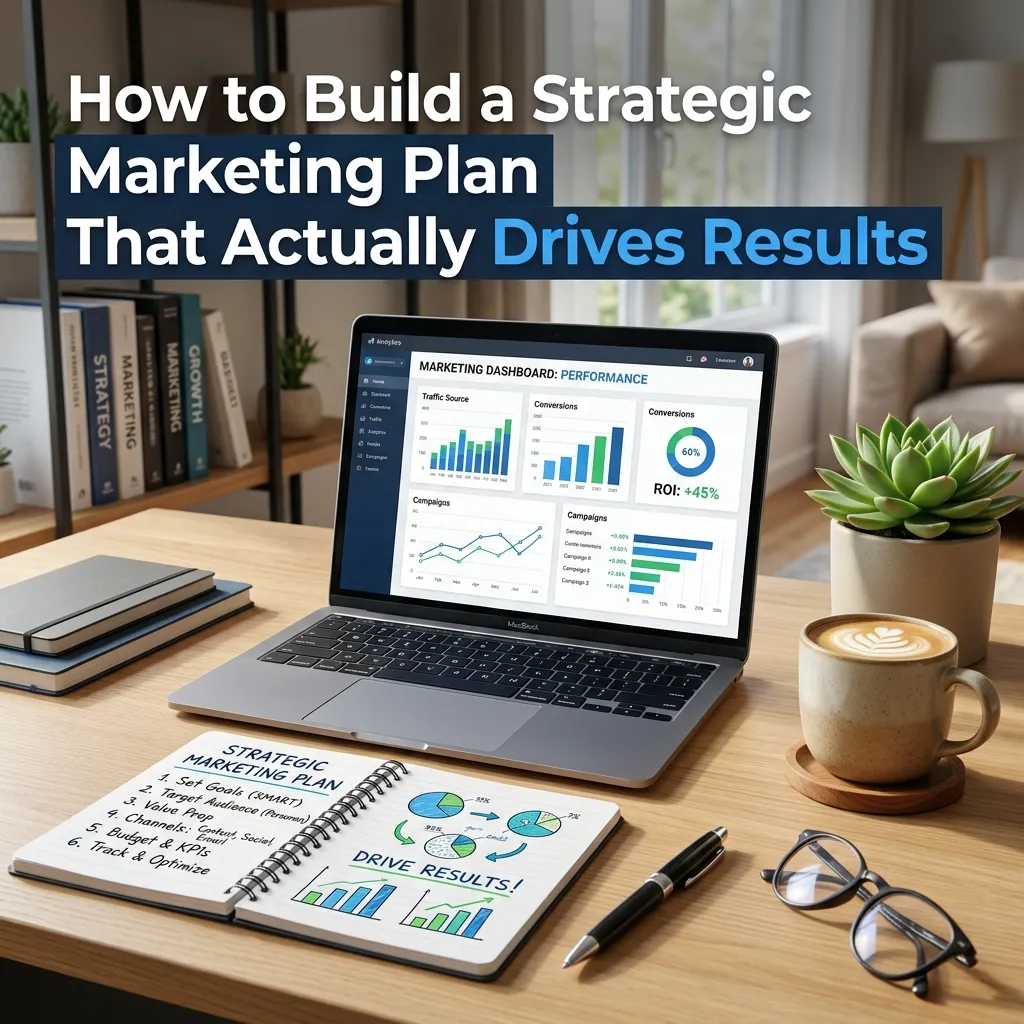
This blog explains how a strategic marketing plan drives business growth through market research, SMART goals, audience targeting, budgeting, AI-driven analytics, and execution frameworks. It highlights planning, automation, customer insights, and data-driven strategies for sustainable success.
Every successful business shares one hidden trait: they never rely on guesswork to find their customers. Instead, they follow a deliberate, well-documented roadmap. A strategic marketing plan removes the mystery from revenue growth and aligns your daily actions with your biggest business goals.
Without a clear blueprint, marketing teams often waste resources on scattered tactics. You might launch a social media campaign or run a few digital ads, but those efforts rarely build long-term momentum if they lack a central focus. A strategic marketing plan ensures every dollar and hour spent contributes directly to your company’s growth.
Many professionals confuse a basic marketing strategy with a comprehensive strategic marketing plan. While a marketing strategy outlines the broad overview of your goals, the strategic marketing plan dictates the specific execution. It breaks down high-level concepts into actionable steps, assigning responsibilities and strict deadlines to keep your team completely accountable.
By reading this guide, you will learn the exact framework top organizations use to scale their revenue. We will explore the essential components of a robust strategic marketing plan, walk through a step-by-step development process, and identify the tools you need to execute your vision flawlessly.
Key Components of a Strategic Marketing Plan
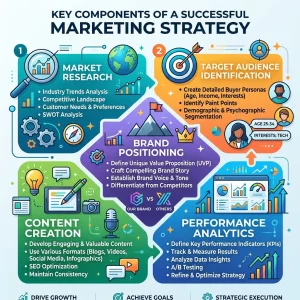
A comprehensive strategic marketing plan leaves absolutely no room for ambiguity. It must cover several critical areas to guide your team from initial concept to final execution. Missing even one of these components can severely weaken your strategic marketing efforts.
The Executive Summary
This section provides a high-level overview of the entire strategic marketing plan. It summarizes the main goals, expected outcomes, and necessary budget. Executives and stakeholders usually read this first to grasp the project’s overall scope before diving into the granular details. Keep this section concise but impactful.
Situational Analysis (SWOT and PESTEL)
You cannot map out where you are going without understanding where you currently stand. A situational analysis anchors your strategic marketing plan in reality.
- SWOT Analysis: This identifies your internal Strengths and Weaknesses, alongside external Opportunities and Threats.
- PESTEL Analysis: This framework examines the Political, Economic, Social, Technological, Environmental, and Legal factors directly impacting your target market.
Target Audience Definition
Your product is not for everyone, and your strategic marketing plan must reflect this reality. This section clearly defines your ideal customer profiles and buyer personas. It outlines their core demographics, psychographics, daily pain points, and specific purchasing behaviors.
Creating Buyer Personas
When building a strategic marketing plan, detail the exact age, location, income, and interests of your buyers. This data ensures your marketing strategy resonates with the right people at the right time.
Marketing Objectives (SMART Goals)
Vague goals produce vague results. Use the SMART framework to set objectives that are Specific, Measurable, Achievable, Relevant, and Time-bound. For example, instead of saying “increase website traffic,” your strategic marketing plan should state “increase organic website traffic by 20% by the end of Q3.”
Marketing Strategy (The 4 Ps)
The classic 4 Ps form the core of your approach within your strategic marketing plan.
- Product: What are you selling, and what specific problem does it solve for the user?
- Price: How much does it cost, and how does that compare to your closest competitors?
- Place: Where will customers buy your product?
- Promotion: Which specific channels will you use to communicate with your target audience?
Budget Allocation and Implementation Timeline
Strategic marketing requires a calculated investment. This component breaks down exactly how much money you will spend across different promotional channels, software tools, and personnel.
Furthermore, a timeline transforms your ideas into action. It establishes clear deadlines for campaign launches, content creation, and performance reviews, ensuring everyone knows what needs to happen and exactly when it must occur.
Aligning Your Strategic Marketing Plan with Business Growth
Your marketing strategy cannot exist in a vacuum. It must connect directly to the overarching vision of your company. A strategic marketing plan serves as the engine that powers your broader corporate ambitions.
To achieve sustainable success, you must bridge the gap between daily marketing tactics and long-term corporate expansion.
You can explore a comprehensive business growth strategy to scale effectively.
Integrating these concepts ensures your strategic marketing plan consistently hits the right revenue targets.
When your strategic marketing aligns perfectly with your business growth strategy, every campaign you launch acts as a stepping stone toward market dominance.
Developing Your Strategic Marketing Plan: A Step-by-Step Guide
Creating a winning strategic marketing plan requires a highly methodical approach. Follow these eight steps to build a strategic marketing framework that drives highly predictable results.
Step 1: Define Your Vision and Mission
Start by revisiting your company’s core purpose. Your vision is the future you want to create, while your mission is how you plan to get there. Ensure your strategic marketing plan directly reflects these foundational statements. Every marketing strategy you deploy should push the company closer to its ultimate vision.
Step 2: Conduct Thorough Market Research
Gather concrete, actionable data about your industry, competitors, and potential customers. Look for gaps in the market that your business can fill effectively. Use customer surveys, focus groups, and deep competitor analysis to build a factual foundation for your strategic marketing plan.
Step 3: Identify Your Target Audience
Segment your broad market into highly specific niches. Build detailed buyer personas for each segment. The better you understand your audience’s daily frustrations and desires, the more effectively your strategic marketing plan can communicate with them.
Step 4: Set Clear, Measurable Objectives
Align your marketing goals with broader business objectives. If the company wants to increase total revenue by $1 million this year, calculate exactly how many marketing-qualified leads your team needs to generate to support that target. This math is crucial for a successful strategic marketing plan.
Step 5: Develop Your Tactical Marketing Strategies
With your goals set, flesh out the tactical approach using the 4 Ps mentioned earlier.
- Product Strategy: Highlight unique features and benefits that separate you from competitors.
- Pricing Strategy: Decide if you are competing on supreme value, high-end luxury, or low cost.
- Place Strategy: Choose direct sales, retail partners, or digital e-commerce channels.
- Promotion Strategy: Select your primary growth channels, such as SEO, email marketing, or paid social media advertising.
Step 6: Allocate Your Marketing Budget
Distribute your funds based on the channels most likely to reach your target audience. Leave a small portion of your budget entirely unallocated to test new tactics or adapt to unexpected market changes. A flexible budget is a hallmark of an effective strategic marketing plan.
Step 7: Create an Action Plan and Timeline
Assign highly specific tasks to individual team members. Use a Gantt chart or dedicated project management tool to map out overlapping responsibilities and ensure your campaigns launch exactly on schedule.
Step 8: Implement, Monitor, and Adjust
Launch your campaigns and monitor the incoming data closely. If a specific ad set underperforms, pause it immediately and reallocate the budget. Strategic marketing is a highly iterative process, and agility is your best asset when managing a strategic marketing plan.
Tools and Resources for Strategic Marketing Planning
The right technology stack streamlines your workflow and provides highly accurate data for decision-making. Utilizing the right tools makes executing your strategic marketing plan much easier.
|
Tool Category |
Purpose in Strategic Marketing |
Popular Software Examples |
|---|---|---|
|
Market Research |
Analyzing search trends, competitor traffic, and keyword volume. |
SEMrush, Ahrefs, Statista |
|
CRM Systems |
Tracking prospect interactions and aligning sales with marketing. |
Salesforce, HubSpot, Zoho |
|
Analytics Platforms |
Monitoring website behavior, drop-off rates, and conversion metrics. |
Google Analytics, Mixpanel |
|
Project Management |
Organizing team tasks, deadlines, and campaign deliverables. |
Asana, Trello, Monday.com |
Common Challenges and How to Overcome Them
Even the best strategic marketing plans encounter friction. Anticipating these roadblocks will help your team navigate them smoothly and keep your business growth strategy on track.
Lack of Clear Objectives
When goals are ambiguous, marketing teams lose focus quickly. Overcome this by strictly adhering to the SMART framework within your strategic marketing plan. Revisit your primary goals monthly to ensure everyone remains perfectly aligned.
Insufficient Marketing Budget
Marketing budgets are very often the first to face severe cuts during tough economic times. Defend your budget by consistently tying your strategic marketing activities directly to measurable revenue generation. Use historical data to prove your positive return on investment.
Poor Execution
A brilliant strategic marketing plan fails completely if the execution is sloppy. Appoint a highly dedicated project manager to oversee the timeline, enforce strict deadlines, and ensure high quality control across all campaign deliverables.
Case Studies: Successful Strategic Marketing Plans
Examining real-world examples helps solidify these core marketing concepts. A strong strategic marketing plan looks different depending on the size and scope of the business.
Example 1: Large Tech Corporation
Consider how a global tech giant launches a new smartphone. Their strategic marketing plan involves a massive situational analysis of global supply chains and consumer spending habits. Their target audience is segmented perfectly, allowing for highly tailored messaging. The marketing strategy features a mix of high-production television commercials, influencer partnerships, and targeted digital ads, all meticulously scheduled over a strict six-month timeline.
Example 2: Small Local Business
A local boutique coffee shop operates differently but uses the exact same strategic marketing principles. Their market research consists of analyzing local foot traffic and surveying nearby office workers. Their main objective is to increase morning sales by 30%. The strategic marketing plan focuses on an aggressive localized promotion strategy, partnering with nearby offices for corporate discounts and running geo-targeted social media ads.
Turning Strategy Into Lasting Growth
A well-crafted strategic marketing plan bridges the vast gap between ambitious business goals and daily marketing tasks. It forces you to scrutinize your market, understand your actual customers, and spend your budget with extreme precision.
Remember that a strategic marketing plan is not a static document you create once and store in a dusty drawer. It is a dynamic, living framework. Markets shift, consumer behaviors change rapidly, and new aggressive competitors emerge constantly. Review your core metrics regularly and be fully prepared to pivot your tactical approach while staying true to your overarching business growth strategy. Start gathering your market data today, define your SMART goals, and build a strategic marketing plan that leads your business directly to sustained success.


Frequently Asked Questions
What exactly is a strategic marketing plan?
A strategic marketing plan is a comprehensive document outlining your advertising efforts for the coming year. It details your target audience, marketing objectives, and the specific actions your team will take to achieve those goals. This blueprint ensures every dollar spent contributes directly to your overall revenue targets and business growth.
How does a strategic marketing plan differ from a marketing strategy?
A marketing strategy defines the broad reasoning behind your goals and identifies your target market and value proposition. A strategic marketing plan is the detailed roadmap that explains exactly how and when you will execute that strategy. The plan assigns specific tasks, strict deadlines, and clear budgets to your team members.
Why is a strategic marketing plan important for small businesses?
Small businesses often have limited budgets, making a strategic marketing plan essential for preventing wasted resources. It provides intense focus, ensuring that marketing efforts directly target the most profitable customer segments. This organized approach allows small businesses to compete effectively against much larger competitors in their industry.
How often should we update our strategic marketing plan?
You should review your strategic marketing plan at least once a quarter to ensure your campaigns remain on track. However, a comprehensive update and overhaul should occur annually to account for changing market conditions. Regular reviews allow your team to pivot tactics quickly if certain promotional channels are underperforming.
What is the role of a SWOT analysis in strategic marketing?
A SWOT analysis helps you identify your internal Strengths and Weaknesses, as well as external Opportunities and Threats. It provides a realistic baseline for your strategic marketing plan by highlighting areas where you hold a competitive advantage. This analysis ensures your marketing strategy addresses potential market risks before they become major problems.
How much should a company budget for a strategic marketing plan?
Budgeting for a strategic marketing plan depends heavily on your industry, company size, and overall revenue goals. Many established businesses allocate between 7% and 10% of their total gross revenue to their marketing strategy. Startups and companies looking for rapid business growth often allocate a much higher percentage to capture market share quickly.
What are the 4 Ps in a strategic marketing plan?
The 4 Ps stand for Product, Price, Place, and Promotion, which together form your core marketing mix. Your strategic marketing plan must define what you sell, how much it costs, where customers can buy it, and how you will advertise it. Balancing these four elements effectively is crucial for a successful product launch.
How do we measure the success of a strategic marketing plan?
You measure success by tracking specific Key Performance Indicators (KPIs) outlined during the planning phase. Common metrics include customer acquisition cost, organic website traffic growth, conversion rates, and total return on ad spend. Monitoring these metrics determines if your strategic marketing plan is actually driving profitable business growth.
Who should be involved in creating a strategic marketing plan?
Creating a robust strategic marketing plan requires input from multiple departments across your organization. Marketing leaders, sales directors, product managers, and executive leadership should all collaborate on the document. This cross-functional alignment ensures the marketing strategy accurately reflects the overall business growth strategy.
Can a strategic marketing plan help with customer retention?
Yes, a well-rounded strategic marketing plan focuses on both acquiring new customers and retaining existing ones. It includes specific tactics like email nurturing sequences, loyalty programs, and personalized customer service initiatives. Retaining customers is highly cost-effective and forms a critical pillar of any successful business growth strategy.
