


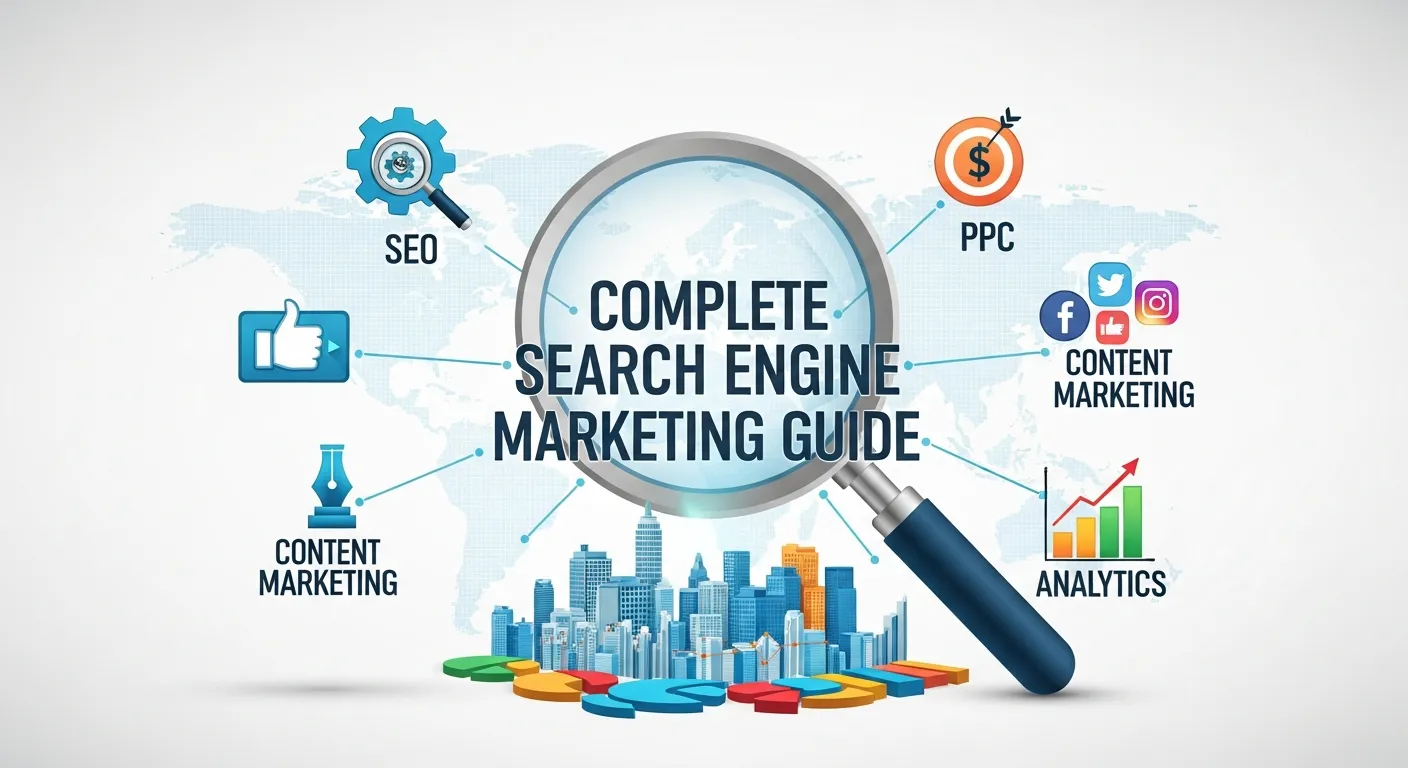
Search engine marketing combines SEO and paid advertising to boost visibility, capture high-intent traffic, and drive conversions. By mastering keyword research, ad copy, analytics, and optimization, businesses can achieve scalable, data-driven online growth.
When a potential customer needs a solution, their first instinct is usually to type a query into a search engine. The results that appear at the very top of that page rarely get there by accident. They are the product of search engine marketing, a highly strategic approach designed to increase a website’s visibility on search engine results pages. Search engine marketing is an essential driver of online growth. It allows businesses to position their products and services directly in front of an audience that is actively looking for them. By leveraging both organic and paid tactics, marketers can capture high-intent traffic, build brand awareness, and drive measurable revenue.
This comprehensive guide covers everything you need to know about building a successful search engine marketing strategy. We break down the core components of search engine advertising, explore the precise mechanics of keyword research, and explain how to craft compelling ad copy. You will also learn how to measure your performance, utilize advanced PPC campaign strategies, and avoid common pitfalls that cost advertisers money. By mastering Google Ads optimization and paid search advertising, you ensure your business remains visible precisely when your customers need you the most.
Understanding the Core Components of Search Engine Marketing
Search engine marketing traditionally encompasses two distinct but deeply complementary disciplines: Search Engine Optimization (SEO) and Pay-Per-Click (PPC) advertising. While some modern definitions use search engine marketing to refer strictly to paid search advertising, a holistic marketing strategy recognizes that both organic and paid efforts work best when carefully aligned.
Search Engine Optimization (SEO) Integration
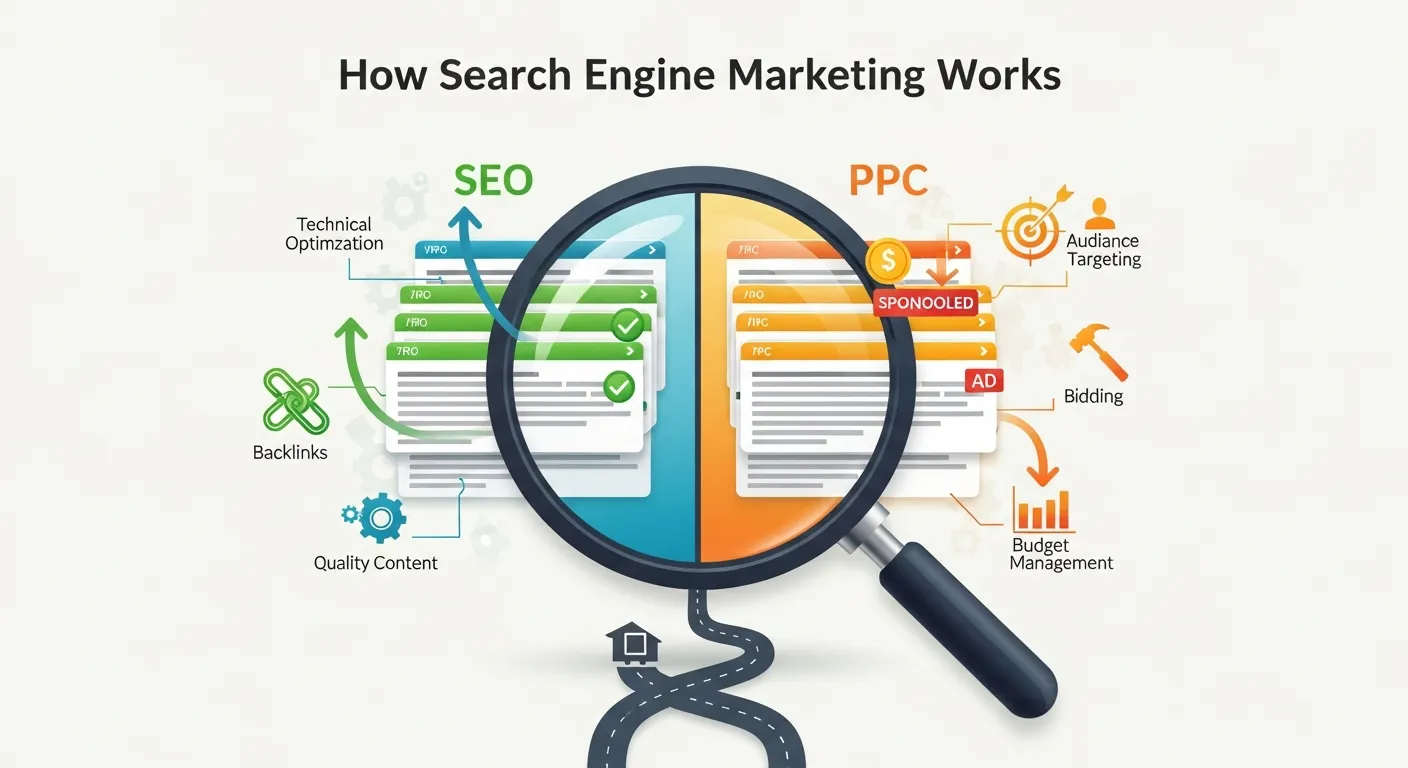
SEO is the practice of optimizing your website to rank higher in organic, non-paid search results. Earning a top spot requires a sustained, deliberate effort across three main areas. Understanding these areas is the first step to mastering overall search engine marketing.
On-Page SEO Techniques
This involves optimizing individual web pages to rank higher and earn more relevant traffic. It includes strategically placing target keywords in titles, headers, and body content. High-quality, relevant content that genuinely satisfies user intent is the most critical element of on-page SEO. When you align your on-page strategy with your paid search advertising efforts, you create a seamless user experience that drives higher conversion rates.
Off-Page SEO Strategies
Search engines use off-page signals to determine a site’s authority and trustworthiness. The primary tactic here is link building—acquiring high-quality backlinks from reputable websites in your specific industry. Social signals, brand mentions, and guest posting also contribute heavily to your off-page profile. These signals tell search engines that your site is a trusted resource, which indirectly supports your search engine advertising campaigns by boosting overall domain authority.
Technical SEO Considerations
A website must be easily crawlable and indexable by search engine bots. Technical SEO focuses on backend improvements like site speed, mobile responsiveness, XML sitemaps, and secure architecture. If your technical SEO is flawed, even the best PPC campaign strategies will fail because users will bounce from a slow, broken site.
Paid Search Advertising (PPC)
Pay-Per-Click advertising allows businesses to bid for ad placement in a search engine’s sponsored links. You only pay when a user actually clicks on your ad. This makes paid search advertising one of the most cost-effective marketing channels available.
Key Differences Between SEO and Paid Search Advertising
|
Feature |
Search Engine Optimization (SEO) |
Paid Search Advertising (PPC) |
|---|---|---|
|
Cost |
Free clicks, but requires time/labor |
Pay per click (CPC) |
|
Speed of Results |
Takes months to see significant traction |
Immediate traffic upon campaign launch |
|
Placement |
Organic search results (middle/bottom) |
Top and bottom of search results (sponsored) |
|
Longevity |
Long-lasting results and traffic |
Traffic stops immediately when budget runs out |
How Search Engine Advertising Works
Advertisers select specific keywords relevant to their business. When a user searches for those exact keywords, an automated auction takes place in milliseconds. The search engine determines which ads to display based on the bid amount and the overall quality of the ad. Mastering this auction process is a core component of search engine marketing.
Google Ads Optimization
Formerly known as Google AdWords, Google Ads is the most popular platform for paid search advertising. It provides robust tools for audience targeting, budget control, and granular performance tracking. Effective Google Ads optimization requires constant attention to detail, tweaking bids, and refining ad copy to maintain high quality scores.
Keyword Research: The Foundation of Search Engine Marketing
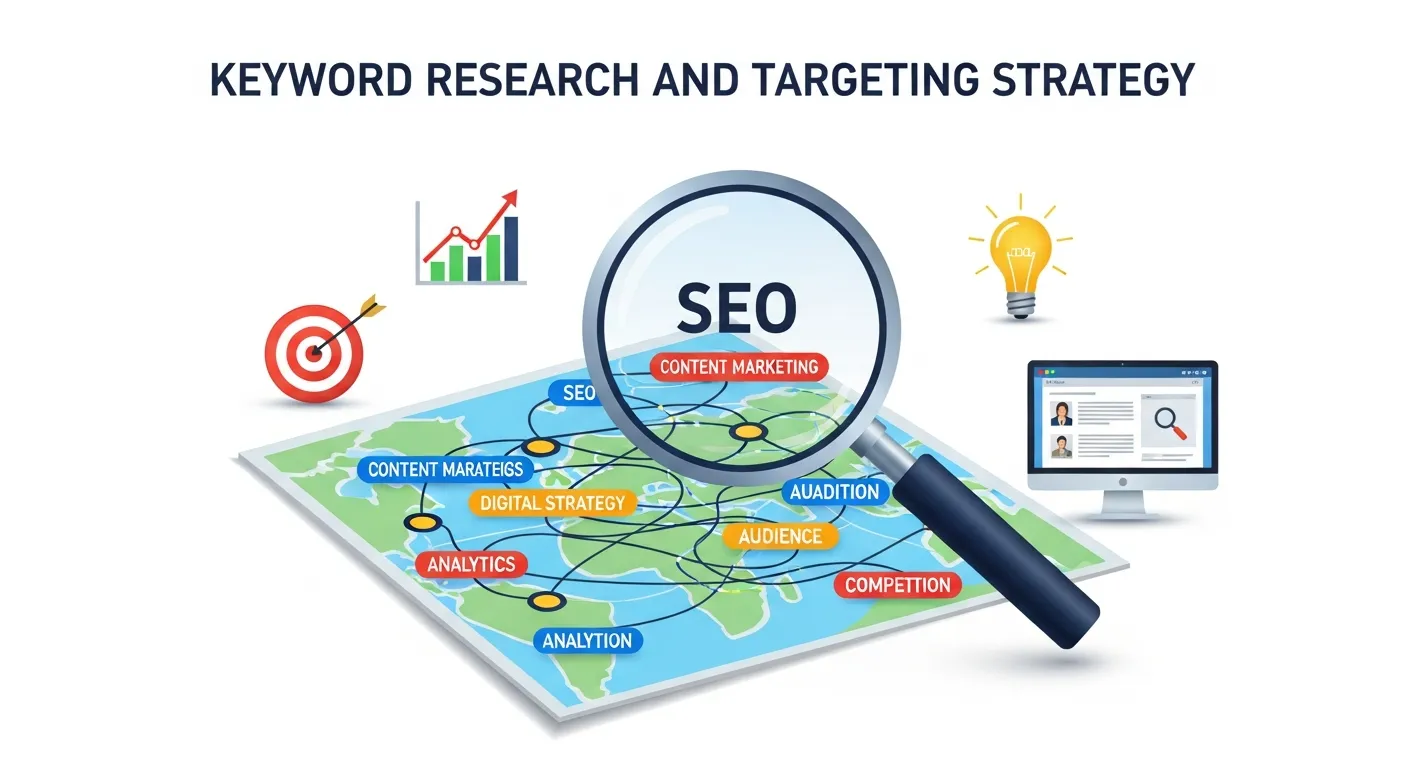
Every successful search engine advertising campaign begins with rigorous keyword research. Understanding exactly what your audience types into the search bar is the absolute only way to meet them at the critical point of decision.
The Importance of Search Intent
Comprehensive keyword research reveals the exact language your customers use. It shows you the monthly search volume and the competition level. Without this critical data, you risk targeting terms that nobody uses or competing for keywords that are far too expensive. Understanding user intent is the secret to effective PPC campaign strategies.
- Informational Intent: The user wants to learn something. (e.g., “what is search engine marketing”)
- Navigational Intent: The user is looking for a specific website. (e.g., “Google Ads login”)
- Transactional Intent: The user is ready to buy. (e.g., “hire search engine marketing agency”)
Balancing Short-Tail and Long-Tail Keywords
A successful search engine marketing strategy meticulously balances short-tail and long-tail keywords.
Short-Tail Keywords
Short-tail keywords have massive search volume but are highly competitive and often lack specific intent. Bidding on these terms in your paid search advertising campaigns can burn through your budget quickly if you are not careful. However, they are excellent for building broad brand awareness.
Long-Tail Keywords
Long-tail keywords have lower search volume but indicate a very specific user intent, often leading to much higher conversion rates. Incorporating long-tail terms is a staple of advanced Google Ads optimization. Because they are specific, they usually carry a lower cost-per-click, making them highly efficient for search engine advertising.
Crafting Effective Ad Copy and Landing Pages
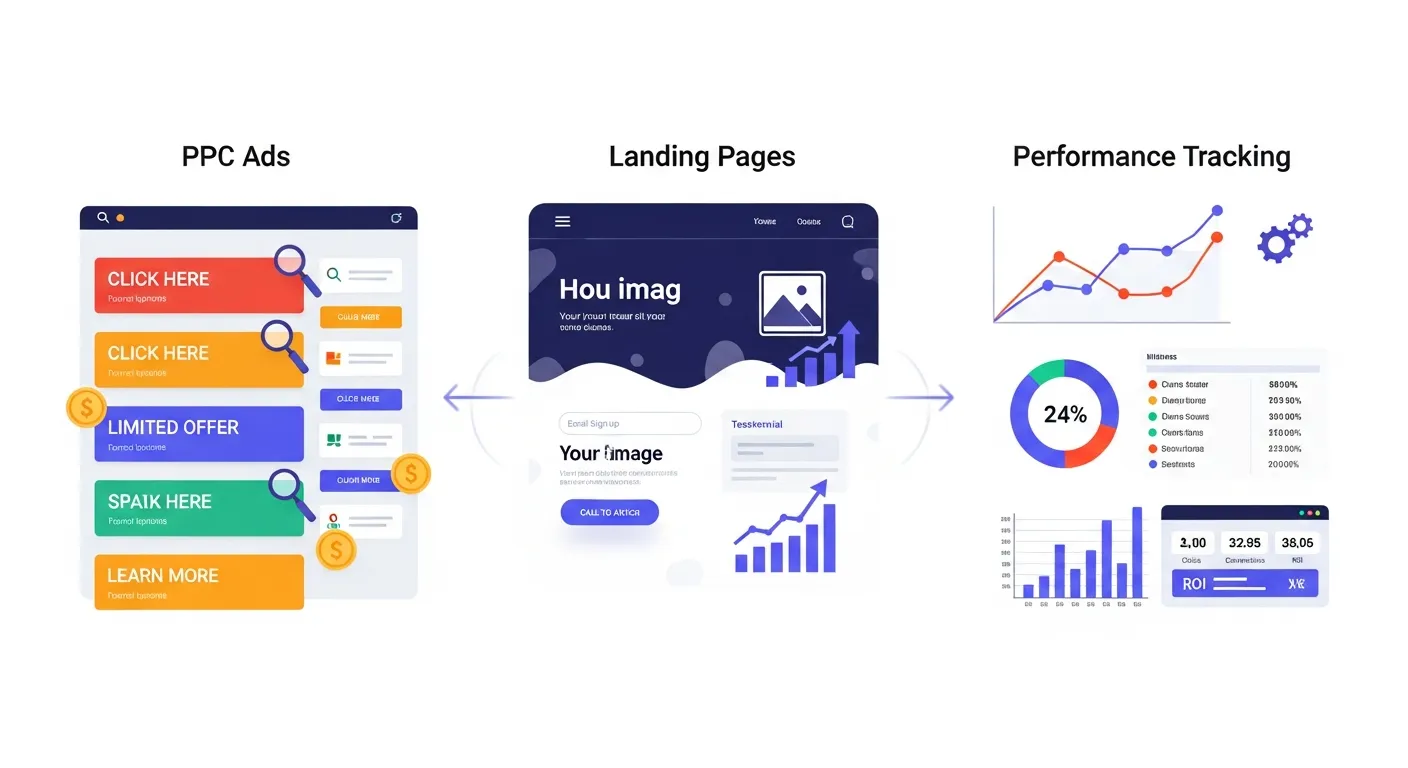
Getting your ad to appear on the screen is only half the battle. You must persuade the user to click, and then convince them to take action once they arrive on your site. This requires mastering the art of search engine marketing copywriting.
Principles of Persuasive Search Engine Advertising
Effective ad copy is highly relevant to the user’s specific search query. Include a strong call-to-action (CTA) that tells the user exactly what to do next. Highlighting unique value propositions—like free shipping, money-back guarantees, or special seasonal discounts—helps your ad stand out from the fierce competition.
A/B Testing Your PPC Campaign Strategies
You should never rely on a single version of an ad. Continuous A/B testing involves running two slightly different ad variations simultaneously to see which performs better. You might test different headlines, CTAs, or display URLs. Continuous testing allows you to refine your search engine marketing messaging based on actual user behavior. For deeper insights into managing and refining these campaigns, exploring proper PPC optimization techniques is highly recommended for maximizing your budget.
Designing High-Converting Landing Pages
When a user clicks your paid search advertising link, they should land on a page that directly matches the specific promise made in the copy. Sending paid traffic to a generic homepage is a massive mistake that severely hurts conversion rates. A high-converting landing page has a clear, singular focus. It minimizes distractions by removing standard navigation menus and uses compelling copy to drive the sale.
Measuring and Optimizing Search Engine Marketing Performance
One of the greatest advantages of search engine marketing is its absolute measurability. You can track nearly every user interaction, allowing for precise Google Ads optimization and budget management.
Key Performance Indicators (KPIs)
To gauge the success of your search engine marketing efforts, you need to monitor KPIs diligently.
- Click-Through Rate (CTR): The percentage of people who click your ad after seeing it. High CTR indicates strong ad relevance.
- Cost Per Click (CPC): The actual price you pay for each ad click. Lowering CPC is a primary goal of Google Ads optimization.
- Conversion Rate: The percentage of clicks that result in a desired action, such as a sale or lead form submission.
- Return on Ad Spend (ROAS): The amount of revenue generated for every dollar spent on paid search advertising.
Leveraging Analytics Tools
Using sophisticated analytics tools gives you a comprehensive, bird’s-eye view of how users behave on your site after clicking your search engine advertising links. You can track individual user journeys, identify exactly which pages generate the most leads, and quickly spot technical errors that might be hindering your overall performance.
Advanced PPC Campaign Strategies
Once you master the basic fundamentals of search engine marketing, advanced techniques can help you squeeze even more value and revenue out of your search engine advertising campaigns.
Remarketing and Retargeting
Remarketing allows you to show targeted ads to users who have previously visited your website but did not complete a conversion. Since these users are already highly familiar with your brand, they are often much more likely to complete a purchase upon seeing a timely reminder ad. This is one of the most profitable PPC campaign strategies available.
Local Search Engine Marketing
Local search engine marketing strategies are absolutely vital for brick-and-mortar businesses with a physical presence. This involves thoroughly optimizing your Google Business Profile and aggressively using location-based keywords in both your organic content and paid search advertising targeting. Geo-targeting ensures your ads only show to users within a specific, profitable radius of your store.
Common Search Engine Advertising Mistakes to Avoid
Even highly experienced marketers can stumble. Avoiding these extremely common mistakes will save your search engine marketing budget and drastically improve your final results.
Neglecting Negative Keywords
Failing to use negative keywords is a remarkably quick way to waste your paid search advertising budget. Negative keywords tell the search engine exactly which terms you do not want your ads to show for. If you sell luxury items, adding “cheap” or “used” as negative keywords prevents your ad from showing to budget-conscious shoppers, instantly improving your Google Ads optimization.
Poor Budget Allocation
Poor budget allocation often occurs when eager advertisers spread their funds far too thin across too many different campaigns. It is almost always more effective to heavily concentrate your budget on a few highly targeted, proven profitable campaigns rather than underfunding a dozen mediocre ones. Strong PPC campaign strategies always prioritize profitability over mere volume.
The Future of Search Engine Marketing
Search engines are evolving at an unprecedented pace, forcing marketers to rethink traditional strategies and embrace continuous adaptation. What worked even a year ago may already be outdated today. The future of search engine marketing is no longer just about bidding on keywords or optimizing basic ad copy—it is increasingly driven by advanced artificial intelligence and machine learning systems that can understand user intent with remarkable accuracy.
Modern search algorithms are becoming extraordinarily sophisticated. Platforms like Google are constantly refining their systems to prioritize authentic user experience, high-quality content, and precise relevance rather than simple keyword density. This means marketers must shift their focus toward creating meaningful, user-first content that genuinely solves problems instead of trying to “game” the algorithm.
In addition, AI-powered tools are now capable of analyzing massive amounts of data in real time, allowing for smarter audience targeting, predictive bidding, and personalized ad experiences. These technologies help marketers deliver the right message to the right user at exactly the right moment, dramatically improving campaign performance.
Another major shift shaping the future is the rise of visual search. Users are no longer limited to typing queries—they can now upload images or use their camera to search instantly. This trend is transforming how products and information are discovered online, pushing marketers to optimize not only text but also images, videos, and other visual assets for search visibility.
Voice search and conversational queries are also playing a growing role. As more users rely on smart assistants, search behavior is becoming more natural and question-based. This requires marketers to adapt their strategies by focusing on long-tail keywords, natural language, and intent-driven content.
Ultimately, the marketers who will succeed in this rapidly changing landscape are those who stay informed, experiment with emerging technologies, and prioritize delivering real value to users. By embracing AI, optimizing for new search formats, and focusing on user-centric strategies, businesses can stay ahead of the curve and dominate the evolving world of search engine marketing for years to come.
Frequently Asked Questions
What is search engine marketing?
Search engine marketing is a digital marketing strategy used to increase the visibility of a website in search engine results pages. It primarily involves paid search advertising, where businesses pay for their ads to appear alongside relevant search queries. This approach drives highly targeted traffic directly to your website.
How does paid search advertising actually work?
Paid search advertising operates on an auction system where advertisers bid on specific keywords relevant to their target audience. When a user searches for that keyword, the search engine displays the winning ads at the top of the page. You only pay a fee when the user actually clicks on your ad.
What are the best PPC campaign strategies for beginners?
Beginners should start with highly specific, long-tail keywords rather than broad, competitive terms. Focus heavily on creating landing pages that directly match the user’s search intent. Start with a modest budget, monitor the data closely, and scale up only the campaigns that demonstrate a positive return.
How important is Google Ads optimization?
Google Ads optimization is absolutely critical for the long-term success of your campaigns. Without regular optimization, your cost per click will rise, and your conversion rates will inevitably drop. Continuous tweaking ensures your budget is spent efficiently on the most profitable search terms.
Can SEO and search engine advertising work together?
Yes, combining SEO and paid search advertising creates a dominant presence on the search results page. Insights gained from your paid campaigns can inform your organic content strategy. For deeper insights into building organic growth alongside paid efforts, check out this SEO strategy development guide.
What is a good return on ad spend (ROAS) for search engine marketing?
A good ROAS varies significantly by industry, profit margins, and specific business goals. Generally, a ROAS of 4:1 (making four dollars for every one dollar spent) is considered strong. Calculating your break-even point is essential before defining your target ROAS.
Why are my paid search advertising campaigns not converting?
Low conversion rates usually stem from a disconnect between the ad copy and the landing page experience. If your landing page is confusing, loads slowly, or lacks a clear call to action, users will leave. Ensure your messaging is consistent from the initial click to the final checkout process.
How do negative keywords improve Google Ads optimization?
Negative keywords prevent your ads from triggering for irrelevant or low-intent search queries. By filtering out bad traffic, you stop wasting money on clicks that will never convert. This directly increases your click-through rate and improves your overall campaign quality score.
Should small businesses invest in search engine advertising?
Yes, search engine advertising offers a highly level playing field where small businesses can compete locally with larger corporations. By utilizing strict geo-targeting and specific niche keywords, small businesses can capture high-intent customers efficiently. It provides predictable, scalable lead generation when managed correctly.
What is the difference between search engine marketing and social media marketing?
Search engine marketing targets users who are actively searching for a specific solution or product. Social media marketing targets users based on their interests, demographics, and general behavior while they browse content. Search marketing captures existing demand, while social media is better for generating new demand.
